Jones and Yarhouse’s ExGay Study
 The latest results from Yarhouse and Jones’ ExGay Study have been published in the Journal of Sex and Marital Therapy and are accompanied by a brand new website allowing for greater interaction with the authors.
The response has been typical. Box Turtle Bulletin (normally a place where one expects a modicum of rigour in their analysis) have essentially ignored any attempt to read the academic paper itself and instead launched into a polemic of straw men and bad science. The usual criticisms are levelled – that the “poor success rate” (23% reported some degree of movement in their sexual orientation, characterised by defining their position on the Kinsey scale) is sign that ex-gay therapy doesn’t work rather misses the point that similar success rates in other areas of psycho-analytics are routinely accepted as evidence that a therapy works for some people. On top of that, probably the most significant outcome that Jones and Yarhouse record is that there is little evidence that ExGay therapy produces long-term psychological harm, even amongst those for whom it isn’t succesful.
Let’s take a closer look at the actual paper, rather then the straw-men. The authors recorded attraction, infatuation and fantasy using the Kinsey scale. For all three markers there was a noticeable shift in the average values recorded across the populations.
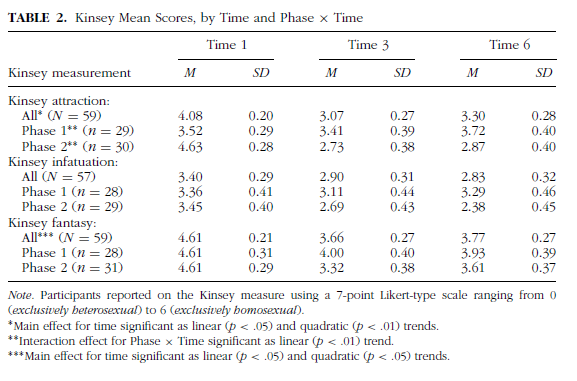
These are important findings. They show that whether it is actual orientation change or change in sexual identity, on average those who exit an ExGay programme report that they are “less gay” (for want of a crude expression) then when they entered. However, none of these trends when comparing the two phases proved to be statistically significant to the extent that the authors could state for certain that this effect (reducing Kinsey ratings across three categories) would always be repeated in similar studies. What this means is that although the research observed empirical evidence that the people studied, on average, reduced their self-reported Kinsey values after going through ExGay Therapy, there is not enough data yet available to argue that such therapy would be expected to always produce such a result.
Jones and Yarhouse summarised their findings as follows,
Our first hypothesis was that sexual orientation is changeable. If change is taken to mean a reduction in homosexual attraction and an increase in heterosexual attraction, we found evidence that successful change of sexual orientation occurred for some individuals concurrent with involvement in the religiously mediated change methods of Exodus Ministries (23% of the T6 sample by qualitative self-categorization). Those who report a successful heterosexual adjustment regard themselves as having changed their sexual orientation. For conventionally religious persons, a reduction in homosexual attraction and stable behavioral chastity as reported by 30% of the T6 sample may also be regarded as a successful outcome. Those who report chastity regard themselves as having reestablished their sexual identities to be defined in some way other than by their homosexual attractions. No data emerging from this study suggest that this is a maladaptive or unsustainable outcome.
Phase 1 participants, those inducted into the study early in their change venture, appear to be disproportionately represented among the more negative qualitative outcomes and had more modest quantitative outcomes. This may indicate that positive outcomes for those first initiating the change process are likely less positive than the overall findings of this study would suggest, that the change process is difficult and requires extraordinary persistence to attain success, or other possibilities. There were, however, some Phase 1 participants in all qualitative outcome categories.
We need to remind ourselves that “successful heterosexual adjustment” is not defined as becoming “100% straight” (which is the straw-man that BTB and others wish to attack), but rather is moving to a position where the individual feels capable of comfortably operating within a heterosexual relationship. Critics might bandy around the language of “bisexuality”, but this shift is often (as the authors identify) far more to do with sexual identity and in particular a sense of being released from needing to identify as “gay”. This post-gay perspective is exactly what I’ve been writing about here for a number of years. The authors continue,
In light of the role of attributions and meaning in sexual identity labeling, is it possible as well that some of what is reported in this study as change of orientation (i.e., the outcomes experienced by the Success: Conversion participants) is more accurately understood as change in sexual identity? An interesting observation about this data is that most of the change that was reported on the self-report measures occurred early in the change attempt. Our previous report (Jones & Yarhouse, 2007) indicated that this change most commonly occurred between T1 and T2, and that the shift that occurred was sustained through T3. The present data suggest such change can be sustained through T6 for those who report successful change. These findings go against the common argument that change of orientation is gradual and occurs over an extended period of time. Some may see these results as reflecting not a change in sexual orientation for most participants who reported such change, but rather a change in sexual identity. Such a change might result from how one thinks of oneself and labels one’s sexual preferences (i.e., attributions and meaning making). It is also possible, though, that this data reflects persons who experienced a change in orientation and a change in sexual identity. In some individuals, a shift in sexual identity might subsequently be consolidated as true shift in sexual orientation. The Kinsey measures of sexual attraction and sexual fantasy would seem to measure some of the fundamental dimensions of sexual orientation. The shifts reported appear to be consolidated and sustained over time for those who reported a successful outcome at T6. It certainly appears from this data that the process of change is complex and multifaceted.
It strikes me that if those implacably opposed to the idea of sexual orientation and identity change want to critique this research, they need to do better than just set-up straw-men that the authors have already themselves rejected, Rather, they should engage further with the actual paper itself and the hard results, and in particular the emphasised hypothesis above that orientation change may be a subsequent effect to identity change, an hypothesis that challenges the common assumption that sexual desire is biologically innate and cannot be altered. As this research shows, it has now been empirically recorded that such sexual desire can and does change in some individuals over time, especially when they place themselves in environments that support such a journey.
Another nice try Dad,â€straw men, ad hom†and now “red herring†you cry. Anything it seems to avoid responding to the substance of our posts. What other rhetorical device are you going to accuse us of before you get down to answering Ryan’s and my questions?
Good point. I’ll repost some of Dad’s key lies and points-ignored here, to save him the scrolling-up (and, perhaps, anyone else from doubts about his m.o.:
LOL! Tell you what Dad, stop ignoring my points and then mibbees you can start expounding on Straw Men?
YOU raised the point that homosexuality is not desireable and ergo ought to be condemned by society
I never said that YOU called Peter an “anti-gay†activist; I used it show that “activist†a TERM THAT YOU USED can indeed be used as a slam.
Of course, anyone can scroll up and see that you’re lying (or, let’s be charitable, ‘misrepresenting’) and make their own judgments about your ‘integrity’ (!). Here’s one good example to make the point.
You:
Ryan: There are other side effects of anti-depressants and anti-psychotics such as tardive dyskinesia. I never said otherwise. Strawman.
This is what you originally gave as the relevant side-effects, accusing me of exaggerating on the dangers of medication:
You intentionally blur side effects such as dry mouth or decreased libido (untreated major depression also decreases libido).
Anyone can scroll up and see your distortions for all the other points – that, again, you choose to ignore. You do of course realise that merely calling something “Straw†– when it is, however ludicrous, the position that your own posts have argued for is more than a little self-negating? Useful for us dodgy liberals tho, so knock yourself out.
Actually, here’s another example:
You: Ryan: “I responded to your point that homosexuality is intrinsically inferior to heterosexuality.†Where did I say that? Another…straw man. I argue that there significantly co-morbidities associated homosexuality, something the APA said wasn’t the case.
And, from one of your original posts, which, again, anyone can scroll up and see:
Societies get to decide societal norms. Homosexuality is not equivalent to heterosexuality. There are significant physical and mental health risks.
Of course, I more than willing to concede that the latter point COULD mean that you regard homosexuality as “equal, but differentâ€, but given the context of rest of your comments, that would present a very curious (strawman?) choice of interpretation.
I said, “Societies get to decide societal norms. Homosexuality is not equivalent to heterosexuality. There are significant physical and mental health risks.”
You then inflated this to my supposedly saying “homosexuality is inferior to heterosexuality”. I did not and would not use the subjective term inferior. That is your first straw man. You also inflated my statement to “YOU raised the point that homosexuality is not desireable and ergo ought to be condemned by society.” Two strawmen for one statement! Impressive. Even the APA acknowledges the role of societal norms in deciding what constitutes disorders.
Here is another of my supposed “lies”:
I never said that YOU called Peter an “anti-gay†activist [nor did I say that you did]; I used it show that “activist†a TERM THAT YOU USED can indeed be used as a slam.”
Let me directly quote myself to avoid your distortions: I said, “Since when is activist is a “slamâ€?” The term activist is obviously neutral, but certainly adding on terms such as “anti-gay”, “neo-nazi”, etc. can take the neutral term and make it into a “slam” (to use your vernacular).
Finally, you seem to not understand the term “such as” as in my statement: “You intentionally blur side effects such as dry mouth or decreased libido (untreated major depression also decreases libido).” I did not say there were not other side effects such as tardive dyskinesia. Tardive dyskinesia is a serious side effect but small in comparison to untreated schizophrenia. See the “such as” part. That isn’t so hard.
There. Your irrelevant strawmen are dismissed.
let’s do this backwards, mr “I know the phrase ‘Straw Man’ and can therefore debate like a grown up!”
“Finally, you seem to not understand the term “such as†as in my statement: “You intentionally blur side effects such as dry mouth or decreased libido (untreated major depression also decreases libido).†I did not say there were not other side effects such as tardive dyskinesia. Tardive dyskinesia is a serious side effect but small in comparison to untreated schizophrenia. See the “such as†part. That isn’t so hard.
I see you’ve clipped all the context, which anyone can scroll up and read. You said that no drug would be approved that would have the health dangers of homosexuality. I provided an example which proves that you are demonstrably wrong
The only Strawman here is you claiming that I claimed that you had provided an exhaustive list of side effects but ommitted TD. The TEXT THAT YOURSELF JUST CITED does however show you claiming that I am “blurring” the side effects profiles of drugs when the only one misrepresenting the severity of such side-effects is you.
“””Let me directly quote myself to avoid your distortions””” ah, and the text you quote is from after I called you on “activist”, and you were engaged in some ass-covering. Nice Try
And as with above, let me provide the context to negate YOUR distortions.
You used “activist” as a slur contrasting me and Tom with your “scientific” (!) self. Here is the quote, which ANYONE CAN SCROLL UP AND READ :
Tom and Ryan demonstrate my point well about how medical science has been poisoned. A scientist must be neutral. Activists like Tom and Ryan are anything but.
I am not claiming that “activist” is a slur in any and all contexts, and you well know this. In fact you claiming that I was doing so is an example of your characteristic lies and, yes, Straw Men.
“”””You then inflated this to my supposedly saying “homosexuality is inferior to heterosexualityâ€. I did not and would not use the subjective term inferior. That is your first straw man. You also inflated my statement to “YOU raised the point that homosexuality is not desireable and ergo ought to be condemned by society.†Two strawmen for one statement! Impressive. Even the APA acknowledges the role of societal norms in deciding what constitutes disorders.
“””
Indeed, and wouldn’t most people say that, in the everyday use of the term, a mental ILNESS or DISORDER is inferior to HEALTH or EASE. And, rather than invoking Straw Man, I said that it IS of course possible that you might think that homosexuality is merely “different, but equal” to heterosexual. This whole discussion started with you saying that homosexuality should not have been declassified as a mental illness, you then proceeds to provide lots of nasty stats on the intrinsic wrongs of homosexuality. If a person spoke at length on how ontological nature is x is demonstrably defective/disordered/ill in a way not true of y then is it really a straw man to characterise their position as saying x as “inferior” to y? To clarify, are you really saying that you don’t regard homosexuality as “inferior” to heterosexuality even although you regard the former as an illness or intrinsic disorder? </B? If you're answer is yes, then I shall of course apologise, but it's a bit silly to accuse me of saying you regard homosexuality as inferior to heterosexuality when YOU YOURSELF have cited article after article above supporting your case that homosexuality IS a mental illness and ought not to have been declassified by the APA.
And:
And Ryan thinks that co-morbidities are small, here is an article that could not be written in the oppressive politicized atmosphere of today
Try googling AIDS crisis, ACT UP, “we die, they do nothing” etc etc. The general response to the gay lobby to HIV/AIDS was to decry the insufficient responses to a very serious disease not to pretend that the gay community was not being affected by it. In fact one, justifiable, contentious was that, if HIV/AIDS was largely affected a group other than homosexuals, then it would have received a far more serious Government response. “GRID” was abandoned because it was LESS scientific than HIV (c.f. also the plight of heterosexuals in Africa).
And before the gear up the “Straw!” “Red Herring!” wilfully stupid emotive yada yada, please note that I’m talking more generally your invoked-boogeyman of Political Correctness. The Gay Community or Lobby have , if we’re being logical, very little to gain from pretending that HIV isn’t a significant problem. Quite the opposite.
Would it be provocative to note that your minority of divorced conservatives is a lot bigger minority than some of the minorities of gay people who you appear to draw untenable conclusions from?
“””And yes, evangelical divorce is a red herring. Here is the “logicâ€:
Opponents of homosexual normalization or declassification of its disorderliness are often evangelical Christians. Evangelical Christian divorce is just as high as the general population [not true – see above link]. Therefore we should normalize homosexuality or at the very least, discount their input.
See the wikipedia article here:
http://en.wikipedia.org/wiki/Two_wrongs_make_a_right
In particular, the two wrongs don’t make a right fallacy: “It is often used as a red herring, or an attempt to change or distract from the issue.†Precisely.
And you also can see wikipedia’s article on the straw man:
http://en.wikipedia.org/wiki/Straw_man
Ryan has consistently changed my words and then argued against preposterous falsely attributed propositions. This is a strawman. Ryan then doubles down on his strawmen by using bold font and all caps. Whatever.”””
Wikipedia! I’m very impressed. While you’re brushing up on intellectual fallacies you might want to google “argumentum ad verecundiam”? YOU are the one who has engaged in misdirection and Straw Man. Changing your words is a FALSE ACCUSATION, O Mr Straw Man. I use bold because you keep ignoring key points and there’s only so many hours in the day. Care to address the points I reposted if you’re not busy with the straw, slur, ad hom and lies? Here’s a full list of fallacies for those, giving “Dad’s” repeated lies and misdirection, to engage sensibly with points.
Here’s a good example: YOU said that I was accusing/conflating you with the Westboro Baptists. I Never did such a thing. Nor did Tom. Therefore the citing of Westboro Baptists is an example of YOU creating a Straw Man i.e. that me and Tom have no credibility because we ad hom denounce any questioning of ‘homosexuality’ by smearing those who do so as being on a par with Westboro Baptists
Sorry if you’re offended by bold. Tell you what, if there’s any formatting I could use that will stop you lying, smearing, ad hom etc etc etc then please do let me know okay?
Also, “such as” isn’t the get out of jail card you seem to think it is. If someone said something along the lines of
x has side effects such as
but then neglects the most common and serious ones (which you did) then they are at the least potentially still guilty of distortion and trying to mislead. Especially, if, like you, they are contrasting x with something else. You were the one who said that homosexuality has health problems that would not be allowed in any drug. You were, and are, flat out wrong.
Man, this is a popular thread.
I got 117 comments but a bitch aint’ one?
;-)
Also, Dad, the figure about evangelical divorce has complications implications far other than the Red Herring you cite. It’s more about a desire to expose hypocrisy – and reveling in this, whether it’s left wing to right wing or vice versa is not, I concede the most Christian of impulses! And then there’s the other implication, that the figure you yourself cited is still far higher than the sort of minority percentiles that might, entirely hypothetically speaking, be used to demonise “gays”… ;-)
Oh, and Dad, since, being a nice guy, I’m willing to concede that it might be theoretically possible for someone to produce reams and reams of “evidence” damning homosexuality, claim that homosexuality should not have been delisted as a mental disorder and yet still not regard homosexuality as inferior to heterosexuality (!), perhaps you could stop accusing me of demonstrating my *personal* acceptance/love of BDSM when I was, as you damn well know, talking about a GENERAL DISCTINCTION between a particular sexual behaviour and sexual abuse that leads to said behaviour. Treat the paraphilia but don’t treat the abuse is not much of a treatment plan.
And I note Dad that it was you was shifted from science to theology, making it highly pertinent to whether or not you can build a Scriptural case for particular behaviours *in and of themselves* being sick/wrong. You have failed to even attempt this. I probably find BDSM just as “icky” (for want of a better word) as you; that emotional response is hardly a good reason to regard it as intrinsically disordered! (for example, a man contemplating a married couple having sex for his own arousal should very much have a disgusted response to that temptation, but the marital sex act itself is hardly sinful of course!). Similarly (you might be surprised to hear, which depresses me) I too find rimming disgusting. But of course the fact that oral sex is *less* disgusting than rimming hardly makes it self-evidently good/non-disordered/holy – c.f. the STD rates Tom cites! As I said earlier:
Tom, have we decided that the APA was wrong and are moving on? Are you saying that the APA was wrong but we should ignore it so that homosexuals aren’t demonized?
Ryan brings up “normal, healthy BDSM.†This makes my stomach turn. He needs to read the song of Solomon to see the true (God’s) intent of sexual intimacy. The world and Satan hate it. They pervert it into prostitution, rape, abuse, fetishism, etc. But sadomasochism provides another good example of how psychological trauma gives rise to paraphilia. Those practising masochism have a higher rate of history of sexual abuse which they transpose for affection. Do I or others demonize the sad individuals whose notion of sexual intimacy has been so corrupted that debasing substitutes for intimate love?
Just as well there’s no rape in the OT, eh? *rolls eyes*
Ryan thought, evidently mistakenly, that you were speaking scientifically. Presumably, now all unacceptable/pathological sex acts are not those associated with paraphilias but those condemned in Scripture? In that light, I’d draw your attention to John McCarthur rebaking Mark Driscoll “exegesis†of Song of Solomon; reducing Scripture to a graphic, pornographic list of permitted sex acts is far more of a slur than anything you can accuse the “gay lobby†of. And of course cultural modes changes. Conservative sites like Christianity Today now , generally speaking, say that anal sex per se is wrong but that oral sex is normal and natural. Mark Driscoll has said that an erotic photo of one’s wife is a “redeemed image†and so it’s perfectly ok to masturbate to (on?) it. Do you really such sites and types would have taken those positions 30 or 40 years ago? If you can mount a proof-texted case (science having failed you yet again) of why oral sex is good but anal sex is not then I’d love to hear it.
And note, again, all the points above that you’ve still to address. Might make a nice change from lies and ad hom slurs eh?
speaking of slurs, I was not of course giving my OWN VIEWS on BDSM which (for the record) I have never had any interest in (also for the record: I couldn’t be more celibate if I tried). Nice try.
Rimming is not exclusively practised by homosexuals – though those good evangelical Christians who lurk on gay porn sites (I wonder why??) – (like that pastor Ssempa from Uganda who does demonstrations of rimming kisses his closed hand to simulate an anus) would have us believe otherwise.
I was told by a friend that when he was first rimmed by his girlfriend he jumped a bit so she asked “Don’t you like it?” He answered “Ye….s, but I won’t be kissing you for three hours”.
You are right Ryan, I thought as much once Dad mentioned Satan that we would not be long shifting from what passes for science to the surer grounds of theology. LOL.
Indeed, Tom, and you’ll note the irony that, when not squawking “Straw Man! Straw Man!” like a particularly dysfunctional parrot, Dad is the one atually engaged in Straw Men. Neither you nor I compared him to the Westboro Baptists. And it was him, not I, who said that homosexuality has dangers that no approved medical treatment has – if he hadn’t said this, then I would hardly have any reason to cite tardive dyskinesia! Addressing points is how grown-up debates, so let’s hope Dad returns to the handily-bolded and repeated points above (of course, ideally one wouldn’t have to bold and capitalise points to get Dad to address them, but I’m nothing if not a realist ;)). And, of course, if he wasn’t accusing me of exaggerating
If memory serves, when I once made a point on the superior orgasms produced by prostate stimulation, Peter indeed conceded that prostate stimulation per se is hardly sinful or unnatural (within the context of marriage of course!). That, although it may lead to brickbats from the more unhinged conservatives, is both commonsensical and logically consistent with the first principles of Natural Law. One wonders if Dad’s eisegis of Song of Songs is similarly broad-minded.
ot a realist ;)). And, of course, if he wasn’t accusing me of exaggerating the dangers of medication then one wonders what the meaning of the blur-the-dangers of mere dry mouth and libdo changes comment is. And the earlier citing of TD in the context of general side effects of *antidepressants* does make later comments smack (although OF COURSE it doesn’t prove, before the “Awk! Straw Man!” Parrot gets its tail pulled again)of some swift corrective goggling.
OK folks, I think it’s time to draw this conversation to a close. Thanks to those who have contributed – I’ll try and write something else you can fall out over very soon!